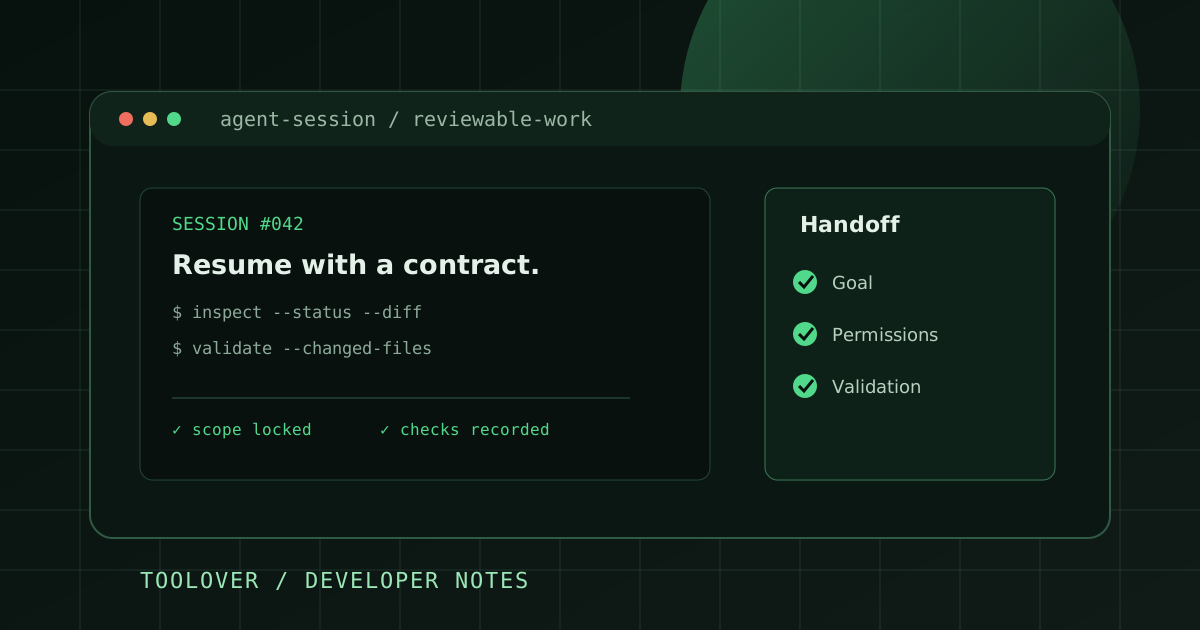
The safest way to use AI coding agent sessions is to treat every session as a reviewable unit of work: define the outcome, limit permissions, record the validation command, and leave a concise handoff before another person or tool resumes it.
This workflow is becoming more practical as developer tools add session continuity and finer controls. GitHub’s August 28 release roundup documents resumable Copilot CLI sessions, configurable execution and permission modes, and easier management of plugins, MCP servers, and skills [1]. Visual Studio Code 1.135, released August 26, adds the ability to continue recent Copilot or Claude sessions from other applications and inspect per-model chat usage [2]. Those features reduce context switching, but they do not replace a human-readable boundary around the work.
What makes an AI coding agent session reviewable?
A session is reviewable when someone who did not watch it can answer five questions: What was requested? What was deliberately excluded? Which files or systems could the agent change? How was the result checked? What remains uncertain? The transcript may help, but the durable record should be the task, the diff, the checks, and the unresolved decisions.
| Session record | Why it matters | Example |
|---|---|---|
| Outcome | Anchors the agent to user-visible behavior | “Add an empty state when a search returns no tools.” |
| Permission boundary | Limits the blast radius of automation | “Edit only the search component and its tests.” |
| Validation command | Makes completion repeatable | pnpm check && pnpm build |
| Handoff | Lets another session resume without guessing | “Implemented; build passes; accessibility review remains.” |
Why resumable sessions need explicit boundaries
Resuming an interrupted agent can save time because the next session can recover context instead of reconstructing it. It can also preserve a mistaken assumption. A resumed session should therefore inherit a small contract, not unlimited authority. Re-read the current diff, re-check the repository status, and restate the next allowed action before asking the agent to continue.
The same principle applies when work moves between a terminal agent and an editor. VS Code’s release notes describe cross-application continuation and a complementary “second opinion” workflow [2]. Use those capabilities to compare reasoning or continue a bounded task, not to bypass review because the previous context feels familiar.
A practical workflow for AI coding agent sessions
1. Start with a narrow task contract
Write one sentence for the desired behavior, followed by non-goals and the files or directories in scope. If the task touches authentication, payments, secrets, deployment, or data deletion, make the approval point explicit. A small contract makes a later resume safer because the agent has less room to reinterpret the task.
2. Choose the least powerful execution mode
Use read-only inspection while exploring, a constrained edit mode for implementation, and a separately approved command for operations that can change external state. GitHub’s current Copilot CLI updates include default execution and permission modes [1], which is a useful reminder to make permissions part of the workflow rather than an afterthought.
3. Keep the working tree observable
Before resuming, inspect the branch, status, diff, and recent validation output. Ask the agent to summarize what it believes changed, then compare that summary with the actual diff. For parallel tasks, a separate Git worktree can reduce accidental file overlap; see TOOlover’s guide to Git worktrees for AI coding agents for the trade-offs.
4. Validate behavior, not just generated code
Run the project’s formatter, type checker, tests, and production build where applicable. Add a realistic failure case instead of relying only on the happy path. The AI coding agent evaluation checklist is a useful companion when the change is large enough to need explicit guardrails.
5. Write a handoff before stopping
End with a compact status note: completed changes, checks run, files intentionally untouched, known limitations, and the next safe action. This is more reliable than expecting a future session to infer intent from a long transcript. If the agent created a specification or acceptance criteria, compare the final diff against it using the practices in the right amount of spec for agentic development.
A copyable handoff template
Paste a version of this note into the issue, pull request, or task record:
Goal: [one sentence describing the user-visible outcome]
Scope: [files, modules, or services allowed to change]
Completed: [what is implemented]
Validation: [commands and results]
Not changed: [important exclusions]
Known limitations: [uncertainty, skipped cases, or follow-up]
Next safe action: [the smallest approved next step]
When to stop and ask for human review
Stop before continuing if the requested change has expanded beyond its stated scope, a validation command fails for an unexplained reason, the agent proposes a permission or dependency change, or the diff touches secrets, deployment configuration, or unrelated files. A resumable session is valuable precisely because it gives you a chance to pause; continuity should not become pressure to accept the first plausible result.
The takeaway
Better AI coding agent sessions are not defined by how long an agent can run without interruption. They are defined by how clearly a developer can resume, inspect, validate, and reject the work. Use session continuity to preserve context, use permission controls to limit risk, and keep a short handoff that makes the next decision explicit.
References
- GitHub Changelog: GitHub Copilot weekly releases — August 24 (August 28, 2026).
- Visual Studio Code 1.135 release notes (August 26, 2026).