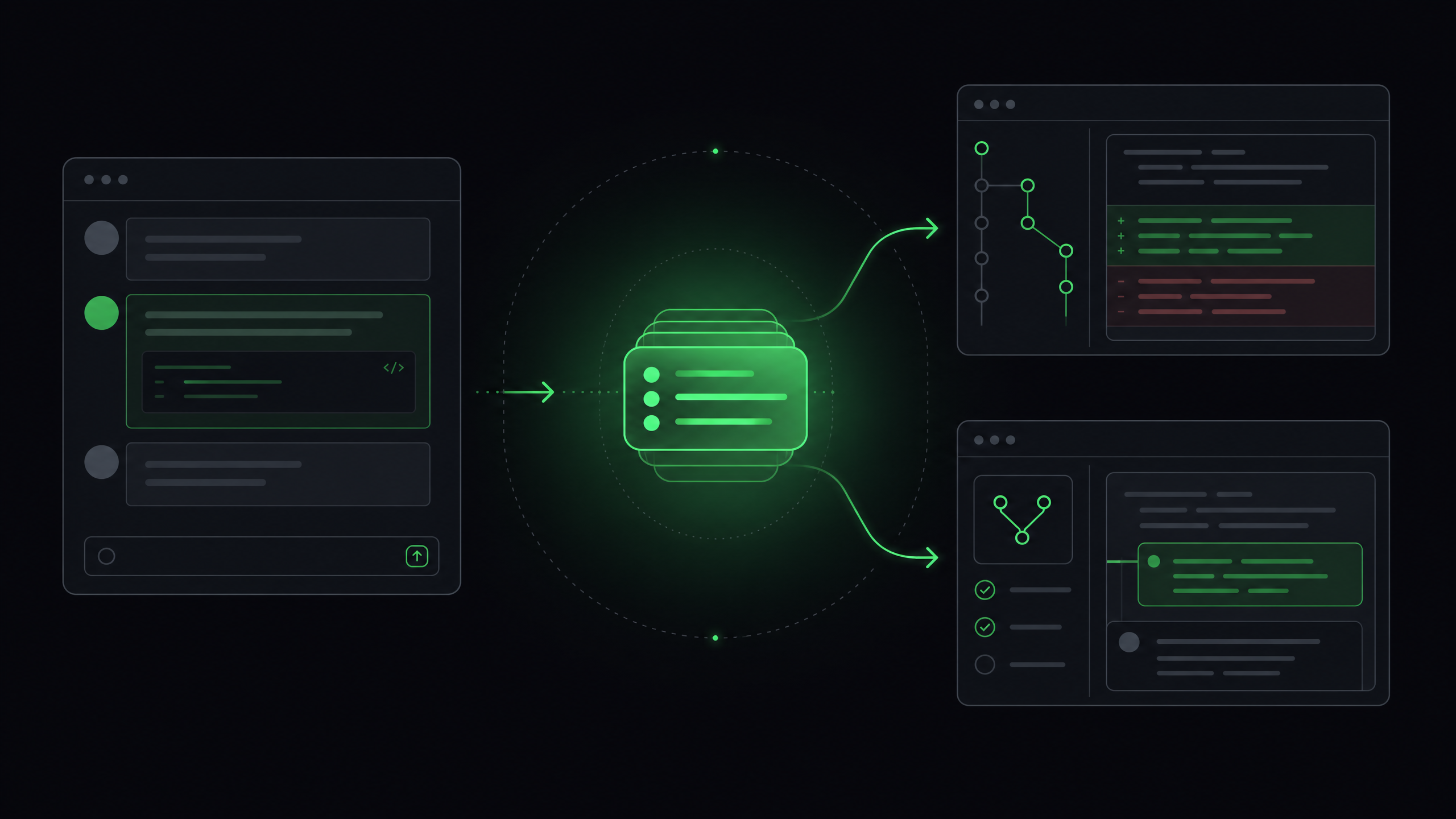
An effective AI coding agent workflow is not “ask an agent to ship and hope.” It is a controlled handoff: define a small outcome, give the agent verifiable boundaries, inspect the diff, run the right checks, and approve only changes you can explain. That workflow matters even more when an agent works asynchronously and returns a pull request while you are doing something else.
This is a practical review loop for coding-agent tasks, informed by the current shift toward asynchronous agent work. GitHub’s August 21 public preview puts Copilot’s agentic capabilities into Slack, including investigation, implementation, validation, and pull-request creation. [1] JetBrains’ August 18 survey also reports that 90% of surveyed professional developers used AI coding agents at work at least weekly in May–July 2026. [2] The useful response is not to remove review; it is to make review more deliberate.
What the workflow should protect
An agent can produce a plausible patch without understanding every constraint around it. Your review process should therefore protect four things: scope, behavior, security, and operability. Scope asks whether the patch solves the requested problem without unrelated cleanup. Behavior asks whether it works for normal, boundary, and failure cases. Security asks whether it changes trust boundaries, data handling, or permissions. Operability asks whether the team can test, deploy, observe, and undo it.
These are review questions, not claims about a particular vendor. They apply whether the work starts in an IDE, a terminal, a pull request, or a team chat. TOOlover’s earlier guide on structuring Claude Code workflows covers the prompt side; this article focuses on what happens after the agent starts changing files.
1. Define a reviewable task before you delegate
Start with an outcome that can be checked from the repository. “Improve the authentication layer” is too broad for a first pass. “Add a test for expired session tokens, update the error message, and leave the token format unchanged” is reviewable because it names the behavior that may change and the behavior that must not change.
Give the agent the same information you would give a new contributor: the relevant files, the command used to test the change, the constraints it must preserve, and a stopping point. Ask it to report assumptions and unresolved questions instead of quietly inventing requirements.
| Task brief element | Useful instruction |
|---|---|
| Outcome | State the user-visible or system-level result in one sentence. |
| Boundaries | Name files, APIs, data formats, or behaviors that must remain unchanged. |
| Checks | List the exact test, typecheck, lint, or build command the agent should run. |
| Stop condition | Require a summary and a proposed diff; do not authorize merging or production access by default. |
2. Keep the agent’s working surface narrow
A narrow working surface makes both the patch and the review easier to reason about. Prefer one issue, one branch, and one coherent change. If the agent discovers a second problem, have it record the finding separately unless fixing it is necessary for the requested behavior.
Parallel agents can be useful for independent experiments, but parallelism increases coordination cost. In a recent OpenAI-published customer story, Asana described using up to four agents in separate copies of a codebase for a migration, with an engineer checking progress twice a day and reviewing every proposed change. [3] That is an attributed example of one team’s process, not a universal staffing or cost benchmark. For a smaller repository, a single agent and a small diff are usually easier to validate.
3. Read the diff before reading the explanation
An agent’s summary is useful, but it is not evidence. Start with the actual diff. Check whether the files changed match the task, whether generated or unrelated files slipped in, and whether the patch introduces new dependencies, configuration, permissions, or network calls.
Then inspect the surrounding code rather than reviewing each changed line in isolation. Look for changes to error paths, defaults, retries, serialization, authentication, and logging. A short diff can still alter a public contract. If the output is JSON, format it before comparing structure; TOOlover’s JSON Formatter is useful for making nested responses readable, and the JSON Validator can check whether a payload remains valid.
4. Test behavior, not just the happy path
Ask the agent to run the project’s existing checks, then add the smallest test that would fail if the requested behavior regressed. Review the test itself: a test that merely repeats the implementation or asserts that a function returns something is not strong evidence.
A compact review matrix helps keep attention on the cases most likely to be missed:
| Case | Question to ask |
|---|---|
| Normal input | Does the requested path still produce the expected result? |
| Empty or malformed input | Does the code fail clearly without leaking data or corrupting state? |
| Repeated request | Is the operation safe to retry, or does it need idempotency protection? |
| Partial dependency failure | Does a timeout or unavailable service produce a bounded, observable failure? |
| Permission boundary | Does the change preserve authorization checks for every affected path? |
5. Treat retries and external actions as high-risk changes
Retry logic deserves special attention because a harmless-looking retry can multiply load or repeat a non-idempotent action. Review the maximum number of attempts, backoff, timeout, cancellation behavior, and whether the operation can safely happen twice. If the agent adds a queue, webhook, deployment step, or database write, ask what happens when the response is lost after the action succeeds.
Recent GitHub incident reporting gives this concern a concrete operational context. GitHub said its August 17 outage lasted 7 hours and 47 minutes, affected multiple services including Actions and Copilot, and that a client-side retry loop increased traffic during recovery. [4] That report does not prove that every retry implementation is unsafe. It does show why retry behavior belongs in the review checklist, especially when an agent is changing networked systems.
6. Make the agent show its work
Before approval, require a compact handoff containing the files changed, commands run, test results, assumptions, known limitations, and any follow-up work. The goal is not verbose chain-of-thought; it is an auditable engineering record. A good handoff lets another developer reproduce the checks without trusting the agent’s confidence.
A practical approval rule is simple: if you cannot explain why the changed code is correct, do not merge it yet. Ask a narrower question, request a focused test, or take over the change manually. This is the same human judgment that matters in ordinary code review, applied to a faster and less predictable contributor.
7. Separate validation from authorization
Passing tests means the checked scenarios passed. It does not grant permission to merge, deploy, rotate credentials, or contact customers. Keep those actions behind explicit human approval, with least-privilege credentials and an easy rollback path. An agent may prepare a pull request; the repository owner still decides whether the change is ready to enter the shared branch.
A small checklist you can reuse
Copy this into an issue or task description when delegating a coding-agent change:
- State the exact outcome and the files or interfaces in scope.
- List behaviors and contracts that must not change.
- Run the project’s required checks and report the commands and results.
- Inspect the complete diff, including dependencies and configuration.
- Test normal, boundary, repeated, failure, and permission-sensitive cases.
- Review retries, external actions, secrets, and data movement separately.
- Require a human decision before merge, deployment, or other irreversible action.
The takeaway
The best AI coding agent workflow makes delegation easy and approval hard enough to be meaningful. Current tools are moving agent work into the conversations and systems where teams already coordinate, and current developer research suggests that agent use is becoming common. [1] [2] That makes a repeatable review loop more valuable, not less: small scope, visible diffs, executable checks, explicit risk review, and a human owner for authorization.
References
- The new GitHub Copilot experience in Slack — GitHub Changelog, August 21, 2026.
- AI Coding Agents: Adoption Trends — JetBrains Research, August 18, 2026.
- Asana cleared 5 years of engineering work in 2 weeks with Codex — OpenAI, August 18, 2026.
- The August 17 outage, and the work ahead — GitHub Blog, August 20, 2026.