Clean code isn't about following rigid rules—it's about writing code that humans can understand easily. These practical principles help you write code that your future self (and teammates) will thank you for.
Naming: The Most Important Skill
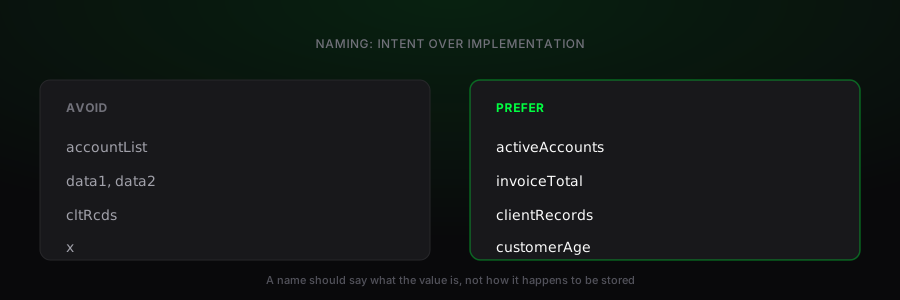
- Use intention-revealing names: customerAge not x
- Avoid disinformation: Don't call a list accountList if it's not actually a list
- Make meaningful distinctions: Don't just data1, data2
- Use pronounceable names: clientRecords not cltRcds
- Use searchable names: Avoid single letters and numeric constants
Functions: Do One Thing Well
- Keep them small: Ideally under 20–25 lines
- Do one thing: If you can extract another function, you're doing more than one thing
- Use descriptive names: The name should describe what it does
- Prefer fewer arguments: Ideal is 0 (niladic), then 1 (monadic); avoid more than 3
- No side effects: Functions should do what their name promises
Comments: When and How to Use Them
- Good code needs few comments: If it needs explaining, it's probably not clear enough
- Comments should explain why, not what: The code shows what, comments explain the reasoning
- Avoid misleading comments: Keep them updated or delete them
- Don't comment bad code—rewrite it: Clear code is better than commented messy code
- Use comments for legal notices or clarifying intent: When the why isn't obvious from context
Formatting for Readability
- Vertical openness: Blank lines separate distinct concepts
- Horizontal alignment: Related items on same horizontal line
- Indentation: Consistent 2 or 4 spaces, never tabs
- Team-wide standards: Use Prettier, Black, gofmt, or similar auto-formatters
- Line length: Aim for 80-120 characters depending on team preference
Objects and Data Structures
- Keep related data together: Group fields that change together
- Prefer data structures over objects when appropriate: Simple data bags vs complex behavior
- Law of Demeter: Only talk to your immediate friends
- Prefer immutability: Reduces cognitive load significantly
- Encapsulate conditionals: Hide complex boolean logic behind functions
Practical Refactoring Techniques
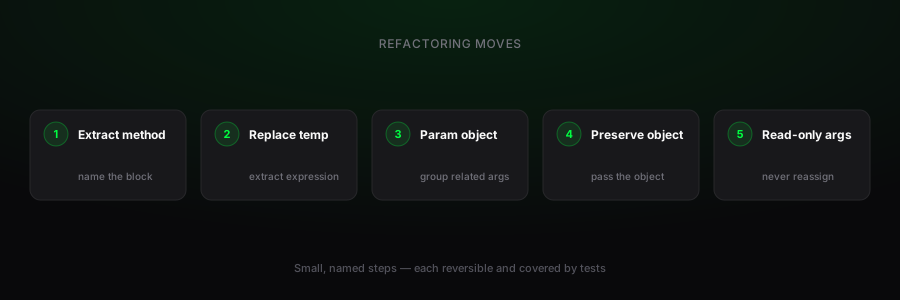
- Extract method: Turn code fragments into named functions
- Replace temp with query: Extract expressions into functions
- Introduce parameter object: Group parameters that often appear together
- Preserve whole object: Pass objects instead of individual fields
- Remove assignments to parameters: Treat parameters as read-only
Writing clean code is a continuous practice, not a one-time achievement. Focus on making small improvements consistently, and over time your codebase will become significantly easier to work with. Remember: the primary audience for your code is other developers, not the computer.