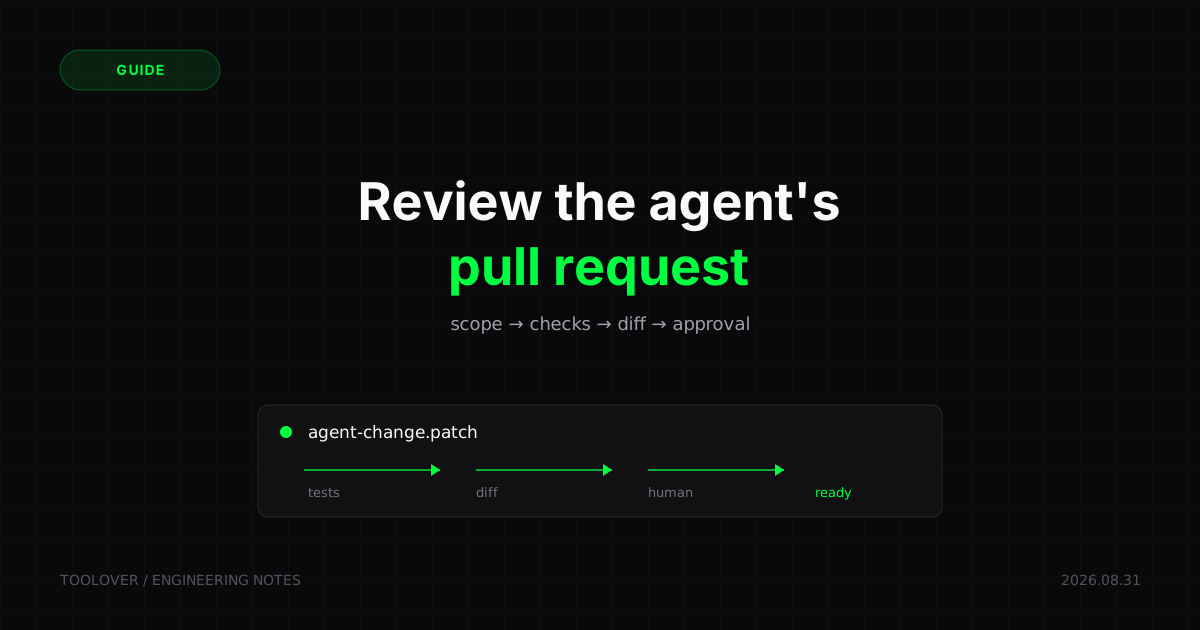
The safest way to review an AI coding agent pull request is to treat it like an evidence-bearing change, not a statement that the code is correct: confirm the intended outcome, inspect the complete diff, run representative checks, and keep a human approval boundary before merge.
That workflow matters more as agents create larger and more autonomous changes. GitHub’s August 27 update says Copilot code review can now review pull requests authored by bots, give Copilot cloud agent pull requests a full agentic review, and review pull requests beyond its former 300-file or 20,000-line limit [1]. More coverage is useful, but it makes a deliberate review protocol more important—not less.
What changed for agent-authored pull requests
A bot-authored pull request changes the review starting point. There may be no developer who remembers every decision in the diff, and a large change can hide a small but consequential behavior change. GitHub’s update also adds resolution reasons—Addressed, Won’t fix, and Incorrect—for Copilot code review comments [1]. Those labels create a useful review record, but they do not decide whether a change meets your product or security requirements.
The practical response is to make the pull request carry its own evidence: a bounded goal, explicit non-goals, commands that were run, results, assumptions, and known risks. The reviewer should be able to reconstruct the decision without trusting the agent’s summary alone.
A five-step AI coding agent pull request review
1. Start with the decision, not the diff
Write down what the change must enable and what must not change. For example: “Add retry handling for transient API failures; do not change authentication, response schemas, or dependency versions.” This gives the reviewer a testable contract and gives the agent a narrow operating boundary.
GitHub’s evaluation guidance recommends starting with the product decision rather than the model and treating offline evaluation like integration testing [2]. For an agent pull request, that means defining acceptance cases before reading a persuasive explanation of how the code works.
2. Check the branch and file boundary
Confirm that the branch is based on the expected target branch and that the changed files are plausible for the request. Look for unrelated refactors, generated files, dependency changes, permission or authorization edits, and configuration changes that expand the blast radius. A small feature with a large diff is a review signal, not automatically a failure—but it needs an explanation.
If an agent is working in parallel, isolated branches or worktrees can reduce accidental overlap. TOOlover’s guide to Git worktrees for AI coding agents covers that separation. Isolation helps with scope; it is not a substitute for reviewing the final diff.
3. Run checks that resemble real use
Run the project’s formatter, type checker, tests, and production build where applicable. Add representative cases for empty input, invalid input, permissions, retries, failure paths, and previously reported bugs. A green test command only proves what the test suite exercised.
GitHub reports a 95% reduction in false positives on its evaluated secret-scanning dataset while keeping recall within a defined guardrail, but it also says offline evaluation cannot prove behavior in every production scenario [2]. Apply the same discipline here: record the result, dataset or fixtures, and the boundary of what the check does not establish.
4. Review behavior, not only lines
Read the diff in slices: public interfaces, data validation, error handling, authorization, persistence, and tests. Ask what happens on the first failure, the second retry, a timeout, a duplicate request, and an unexpected response. Compare the implementation with the stated acceptance cases rather than rewarding code volume.
For a quick mechanical comparison between two text or configuration versions, TOOlover’s Text Diff can help surface changes. For structured configuration, the JSON Validator can check syntax and schema-shaped data. These tools support review; they cannot determine whether the product behavior is correct.
5. Leave a reviewable handoff
Ask the agent or author to leave a concise handoff in the pull request. A useful format is:
Goal: ...
Files changed: ...
Checks run: ...
Results: ...
Not run: ...
Assumptions: ...
Potential risks: ...
Reviewer decision needed: ...
If the handoff cannot explain a changed file or a failed check, pause the review. The goal is not to make the agent sound confident; it is to make the next human decision faster and better informed. TOOlover’s AI coding agent sessions guide covers the same principle for resumable work.
How to handle a large agent pull request
A tool’s ability to review a large pull request is not evidence that the pull request should be large. Prefer a sequence of independently reviewable changes when the work can be decomposed: first add or update tests, then make the behavior change, then remove obsolete code. If decomposition would make the result harder to understand, document why and ask for a focused walkthrough of the riskier sections.
OpenAI’s August 24 announcement about GPT‑5.6 in Kiro describes structured requirements, technical designs, executable tasks, review checkpoints, and property-based testing as parts of an AI-native development workflow [3]. Those are useful patterns to borrow, regardless of which agent or editor you use. OpenAI and AWS also report an approximately 82% cost reduction for one GPT‑5.6 Terra Terminal-Bench 2.1 test in Kiro; that is a vendor-reported, tool-specific result—not a general productivity benchmark [3].
Approval checklist
- Scope: Does the diff implement the stated outcome without unrelated behavior or dependency changes?
- Evidence: Are the relevant tests, fixtures, build commands, and results recorded?
- Failure paths: Are invalid, empty, timeout, retry, duplicate, and permission-sensitive cases covered where relevant?
- Security: Did the change alter secrets, authorization, data access, generated code, or deployment configuration?
- Handoff: Can another reviewer understand the assumptions and remaining risks without rerunning the agent session?
- Decision: Is a human reviewer explicitly approving the change before merge?
If the answer to any critical question is unclear, request a smaller change or more evidence. An AI coding agent can accelerate implementation and review preparation, but the repository’s tests, the diff, and the human approval decision remain the source of truth.
References
- Copilot code review: Resolution reasons and expanded capabilities — GitHub Changelog, August 27, 2026.
- How to evaluate LLMs before production — GitHub Blog, August 25, 2026.
- Advancing price-performance for developers with GPT‑5.6 in Kiro — OpenAI, August 24, 2026.